 Pure
PureHEPA vs Carbon Filter: What Each One Removes
HEPA and carbon aren't rivals — they catch two different kinds of pollution, and a purifier that skimps on one leaves half the problem in the room. HEPA handles what settles on your shelves; carbon handles what you can smell. Here's what each removes, and how much carbon it takes to matter.
Last updated: September 2026 · By the PureAir Lab editorial team
The short answer
A true-HEPA filter traps particles. Activated carbon adsorbs gases and odors. Neither does the other's job, which is why decent purifiers stack both. The real question isn't which to choose — it's whether that carbon stage is a genuine bed or a thin coated screen.
| True-HEPA | Activated carbon | |
|---|---|---|
| How it works | Mechanical — trapped in dense fiber media | Adsorption — gases stick to porous carbon |
| Removes | Dust, pollen, dander, mold spores, dust-mite debris, smoke particles | Smoke smell, cooking odor, VOCs, formaldehyde, benzene |
| Doesn't touch | Gases and odors — pass straight through | Particles — a carbon sheet isn't a particle filter |
| Rated by | 99.97% of particles at 0.3 microns | No consumer standard — carbon weight is the proxy |
| Typical life | 6–12 months | 3–6 months with an active source |
| Washable | No | No — rinsing clears dust, not saturation |
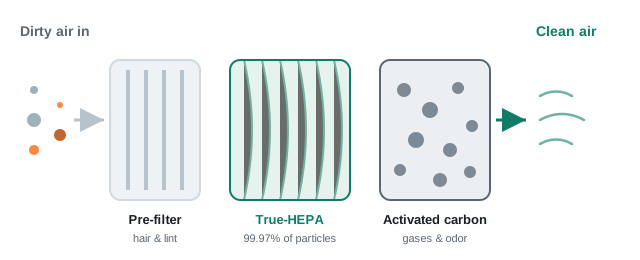
What HEPA removes
HEPA is graded at 0.3 microns because that size is the hardest to catch — the most penetrating particle size. Larger and smaller particles are captured more efficiently — the part most product pages skip. That covers nearly everything floating in a home: pollen at roughly 10–100 microns, mold spores at 3–30, pet dander at 2.5–10, smoke particles down around 0.1–1 micron.
So a plain HEPA machine helps reduce airborne allergens and captures the visible part of smoke. What it won't do is change how a room smells. Mechanics in full: what a HEPA filter is and how air purifiers work.
What carbon removes
Odor and VOC molecules are gases — thousands of times smaller than the particles HEPA media is built for. They pass through HEPA media like air through a window screen. Activated carbon works differently: its pore structure gives an enormous internal surface area, and gas molecules adhere to it until the carbon is full.
That's formaldehyde off-gassing from pressed wood, benzene from paint, cooking fumes, cigarette and cannabis smell. One caveat: plain carbon is weak on ammonia — the litter-box compound — which needs impregnated media, so a standard cartridge won't erase it. Picks by source: smoke and odors, VOCs and chemical fumes.
How much carbon is actually in there
We don't run a lab — we go through published specs and owner reports. The pattern holds: odor performance tracks carbon mass, not marketing.
| Model | Carbon stage | Coverage | Odor verdict |
|---|---|---|---|
| Levoit Core 300 | Thin bonded carbon layer | 219 sq ft, 141 CFM, 24 dB on sleep | Light cooking smells only |
| Coway AP-1512HH | Modest carbon panel | 361 sq ft | Everyday odor, not heavy smoke |
| Winix 5500-2 | Thick carbon pellet filter | 360 sq ft, 243 CFM dust CADR | Best carbon per dollar |
| Austin Air HealthMate | 15 lb granular carbon | ~1500 sq ft | Heavy smoke, chemical sensitivity |
The jump from coated screen to pellets is the one you notice daily. If odor is the complaint, start with the 5500-2.
Check price on AmazonTwo things to know
- Carbon saturates, then gives it back. A HEPA filter gets better at trapping as it loads up. Carbon does the opposite — once its pores are full it stops adsorbing, and in a warm room a saturated filter can re-release what it held — the room that smelled fine in spring going stale by fall on the same cartridge. With an active source, change carbon ahead of the box schedule: replacement intervals, filters guide.
- CADR says nothing about smell. The smoke figure in a CADR rating measures smoke particles, not the molecules carrying the odor. A unit rated 360 sq ft can be excellent on dust and mediocre on smell. Read CADR for sizing, the carbon spec for odor: CADR and room-size math.
Which one you need
Allergies, dust, pet hair, pollen: HEPA does the work — pick on CADR and room size, treat carbon as a bonus. Smoke, cooking, a fresh renovation: buy for carbon weight, and expect a thin layer to fade in weeks. Mold is both at once — HEPA for the spores, carbon for the musty smell — though neither fixes the moisture feeding it: our mold picks. Weighing the filter budget? See are air purifiers worth it.
FAQ
Is a carbon filter better than HEPA?
Neither is better — they remove different things. HEPA traps particles like dust, pollen and dander; carbon adsorbs gases and odors. Carbon alone won't clear dust; HEPA alone won't change how a room smells.
Do I need both HEPA and carbon?
Usually yes, and most decent units include both. If dust or allergens are the only complaint, the carbon stage barely matters. If it's smoke or cooking smell, carbon is the part you're actually buying.
Can you wash or reuse a carbon filter?
No. Rinsing a washable carbon pre-filter clears trapped dust, but it won't free the pores that gas molecules have filled. Saturated carbon stays saturated — replace it.
How long does a carbon filter last?
Roughly 3 to 6 months with an active odor source — a smoker, a busy kitchen, new furniture off-gassing — versus 6 to 12 months for the HEPA stage. In 3-in-1 cartridges the carbon expires first, but you swap the lot anyway.
Does a HEPA filter remove smoke?
It removes the smoke particles — the visible haze, and what CADR measures. The smell is a separate set of gas compounds needing a thick carbon bed, which is why carbon weight decides our smoke picks.