 Pure
PureHow to Choose an Air Purifier
There are only a handful of numbers that actually decide whether an air purifier will work for you. Here's how to read them — CADR, HEPA, room size, noise and running cost — in plain English.
Last updated: July 2026 · By the PureAir Lab editorial team
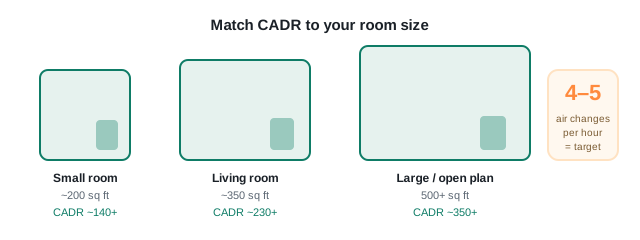
1. Match CADR to your room
CADR (Clean Air Delivery Rate) is the single most useful spec. It tells you how much clean air the unit produces, in cubic feet per minute, for smoke, dust and pollen. A simple rule: for strong cleaning, the smoke CADR should be at least two-thirds of your room's square footage — and equal to it if you have allergies or asthma. That gives roughly 4–5 air changes per hour.
Example: a 300 sq ft living room wants a smoke CADR around 200–300 CFM. Anything much lower will feel underpowered no matter what the box claims.
2. Insist on true-HEPA
Only a true-HEPA filter is certified to capture 99.97% of particles at 0.3 microns. Marketing terms like "HEPA-type," "HEPA-like" or "99% HEPA" are not the same and often perform noticeably worse. If the listing won't say "true-HEPA" or "H13," be sceptical.
3. Check the carbon — if you need it
HEPA captures particles but does nothing for gases and smells. For smoke, cooking odor, mold smell or VOCs you need activated carbon — and the amount matters. A thick pellet or granular carbon filter absorbs odor for months; a thin carbon-coated screen is nearly cosmetic. If odor is your problem, weight this heavily.
4. Weigh the noise
Look at the lowest noise figure, not the maximum, because you'll usually run the unit on low or auto. Around 24 dB or under is bedroom-quiet. A big purifier run on medium is often quieter than a small one straining on high — another reason to size up.
5. Add up the running cost
The sticker price is only part of it. Estimate the annual filter cost (HEPA every 6–12 months, carbon sometimes sooner) and the wattage if you'll run it 24/7. Cheap units with expensive proprietary filters can cost more over three years than a pricier unit with affordable refills. Our filters guide covers this.
6. Skip the gimmicks
- Ozone generators — avoid. Ozone is a lung irritant; it isn't a safe way to clean indoor air.
- Ionizers — optional at best. Choose units where you can switch them off.
- UV lights — usually too brief a contact time to matter; don't pay a premium for them.
Quick checklist
- CADR ≥ two-thirds of room area (equal if allergic)
- Labelled true-HEPA or H13
- Real activated carbon if you have odors
- Low-speed noise around 24 dB for bedrooms
- Affordable, available replacement filters
- No ozone; ionizer can be turned off
FAQ
What is the most important spec on an air purifier?
CADR. It tells you how fast the unit actually cleans a room. Match it to your square footage before looking at anything else.
Is a more expensive air purifier always better?
No. Past a true-HEPA filter and the right CADR for your room, extra cost mostly buys coverage, quieter fans, sensors and app features. Match the unit to the room rather than the price.
How many air changes per hour do I need?
Four to five per hour is a good target for allergy or smoke relief. That's what sizing CADR to your room area achieves.