 Pure
PureHow Do Air Purifiers Work?
An air purifier is simpler than the marketing suggests: a fan pulls room air through one or more filters, each stage removing something different, and pushes the cleaned air back out. Here's what actually happens inside.
Last updated: July 2026 · By the PureAir Lab editorial team
The basic process
Every filter-based air purifier works the same way. A fan draws in air, forces it through a stack of filters, and returns it to the room. Run it long enough and the whole room's air passes through the filters many times an hour, steadily lowering the level of particles and — with carbon — some gases.
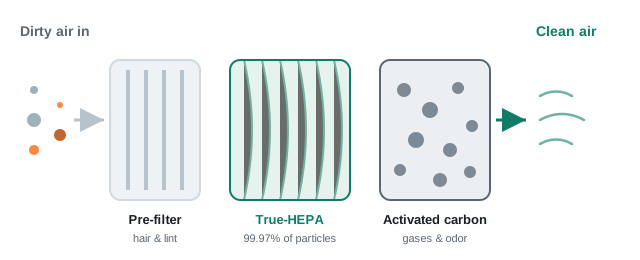
The filter stages
- Pre-filter. A coarse mesh that catches large debris like hair and lint. It's often washable and protects the finer filters behind it.
- True-HEPA filter. The core of the machine. Its dense fiber mat captures 99.97% of particles at 0.3 microns — pollen, dust, dander, mold spores and smoke particulate. Learn more about how HEPA works.
- Activated carbon. A bed of porous carbon that adsorbs gases and odors — smoke smell, cooking fumes, VOCs — which pass straight through HEPA. The more carbon, the more it handles.
How HEPA captures particles
The HEPA mat traps particles three ways at once: larger ones slam into fibers (impaction), mid-size ones brush against them (interception), and the tiniest bounce around randomly until they stick (diffusion). Because of diffusion, HEPA is actually most efficient on ultrafine particles — the opposite of what many people expect.
What the numbers mean
- CADR — Clean Air Delivery Rate, how much clean air the unit produces per minute. Match it to your room size.
- Air changes per hour — how many times the unit cleans the room's full volume hourly. Four to five is a good target.
- Coverage — the room size the maker rates it for, usually optimistic; sizing by CADR is safer.
What air purifiers can't do
They clean the air only while running and only within their coverage. They don't remove particles already settled on surfaces, they don't fix the source of mold or smoke, and HEPA-only units don't touch odors. Ozone generators are a different, best-avoided category — ozone is a lung irritant, not a safe cleaner.
FAQ
How does an air purifier clean the air?
A fan pulls room air through a pre-filter, a true-HEPA filter that traps particles, and often an activated-carbon filter that adsorbs gases, then returns the cleaned air to the room.
Do air purifiers use a lot of power?
No. On low or auto most use only a few to several watts, rising to around 50–70 W on high — far less than heating or cooling. Filters are the main running cost.
How long until the air is cleaner?
A correctly sized unit noticeably lowers particle levels within 30–60 minutes and reaches a low steady state within a couple of hours when run continuously.