 Pure
PureWhat Is a HEPA Filter?
HEPA is the filter standard behind almost every good air purifier — but the word gets stretched by marketing. Here's what a true-HEPA filter really is, how it works, and whether air purifiers actually do anything.
Last updated: July 2026 · By the PureAir Lab editorial team
What HEPA means
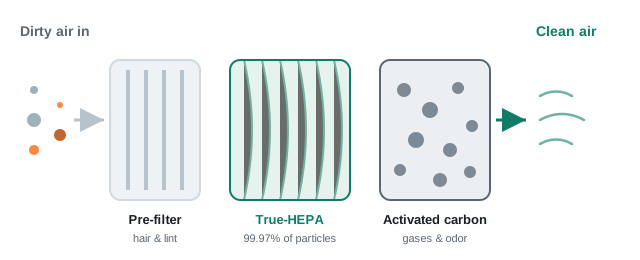
HEPA stands for High-Efficiency Particulate Air. A true-HEPA filter is certified to capture 99.97% of particles at 0.3 microns — the hardest particle size to catch. Grades labelled H13 and H14 (common on newer units) capture even more. That single certified number is what separates real HEPA from lookalikes.
How it actually captures particles
A HEPA filter isn't a simple sieve. Its dense mat of fibers traps particles three ways at once:
- Interception — mid-size particles following the airflow brush against a fiber and stick.
- Impaction — larger, heavier particles can't turn with the air and slam into fibers.
- Diffusion — the tiniest particles bounce around randomly (Brownian motion) and drift into fibers.
Because of diffusion, HEPA is actually more efficient on ultrafine particles smaller than 0.3 microns — the opposite of what most people assume.
"True-HEPA" vs "HEPA-type"
This is where buyers get caught. Only true-HEPA meets the 99.97% standard. Terms like "HEPA-type," "HEPA-like," "99% HEPA" or "HEPA-style" are unregulated and typically capture far fewer fine particles. If a product avoids the words "true-HEPA" or "H13," treat it as a lesser filter.
What HEPA does not do
HEPA captures particles — pollen, dust, dander, smoke particulate, mold spores. It does not remove gases, odors or VOCs, which pass straight through. For smells and smoke odor you need activated carbon as a second stage.
Do air purifiers actually work?
Yes — for airborne particles, the evidence is solid. A correctly sized true-HEPA purifier measurably lowers indoor concentrations of pollen, dust and fine smoke particles (PM2.5), and studies link that to reduced allergy symptoms and better indoor air during wildfire events. The caveats are simple: it only works while it's running, it must be sized to the room, and it manages symptoms rather than removing the source. It won't fix a mold colony or a leaking pipe — it cleans the air around the problem.
FAQ
Is true-HEPA better than HEPA-type?
Yes. True-HEPA is certified to capture 99.97% of particles at 0.3 microns; "HEPA-type" is an unregulated term that usually captures fewer fine particles. Always choose true-HEPA or H13.
Does HEPA remove viruses and smoke?
HEPA captures particles including smoke particulate and particle-bound pathogens. It does not remove smoke odor or gases — that needs activated carbon.
Do air purifiers really work?
For airborne particles, yes — a properly sized true-HEPA unit reliably lowers indoor pollen, dust and PM2.5. It works only while running and doesn't remove the source of a problem.